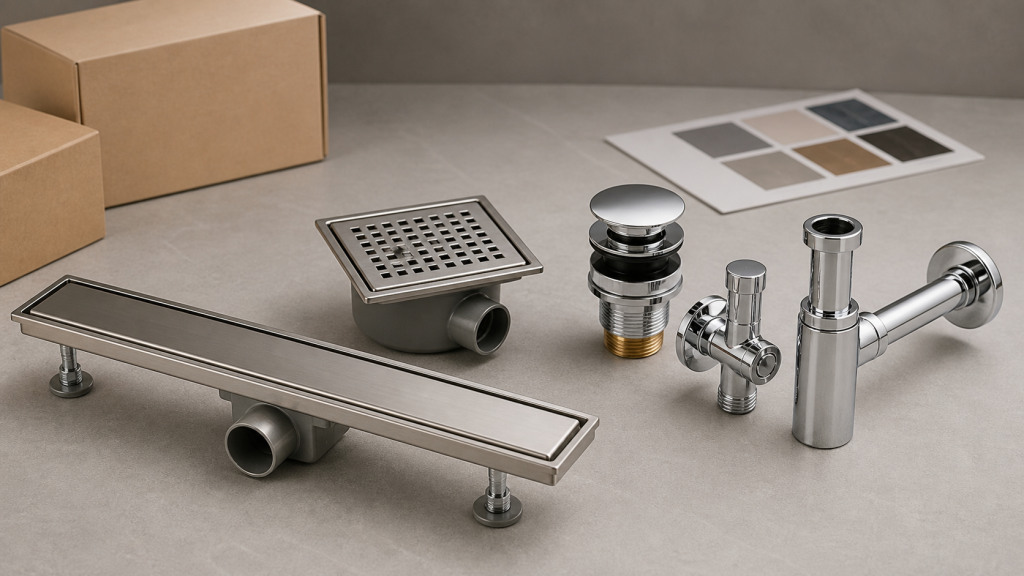
For importers, distributors and project buyers, sourcing bathroom drainage products from China involves more than choosing an attractive finish. Floor drains, basin wastes, bottle traps and angle valves must fit the installation, handle the intended water flow and remain serviceable after the bathroom is completed.
This guide explains how to compare drainage products and suppliers before requesting a quotation. Buyers building a wider assortment can also browse our bathroom and plumbing product range or review our bathroom accessories sourcing guide.
Quick answer: A reliable drainage order starts with exact dimensions, material grades, outlet direction, connection standards, finish references and an agreed test method. Product names alone are not enough.
1. Define the drainage product by installation type
Begin with the building or basin drawing. A linear shower drain may require an adjustable outlet, removable grate and specific channel length. A square tile-insert drain must match the tile build-up and waterproofing detail. Basin wastes need the correct thread, overflow configuration and connection to the trap. Bottle traps must suit the basin outlet and wall connection while leaving enough adjustment during installation.
Information to include in a request for quotation
- Product type and intended application.
- Overall dimensions, outlet size and outlet direction.
- Required material and surface finish.
- Connection thread or pipe standard.
- Overflow or non-overflow basin configuration.
- Drainage rate, water-seal or odor-control requirement.
- Packaging, labeling and target market.
A drawing is usually more reliable than a product photo because visually similar drains can use different outlet structures and installation depths.
2. Compare stainless steel grades for floor drains
SUS304 is a common option for indoor bathroom drainage products. SUS316 may be considered for more demanding environments, but the grade should be verified against the exact order rather than assumed from a catalogue heading. Buyers should also confirm sheet thickness, weld quality, grate fit and the material of the outlet or siphon components.
For a plumbing fittings collection, ask suppliers to separate the channel material, grate material, outlet material and any plastic components in the specification. “Stainless steel drain” does not necessarily mean every component is stainless steel.
Useful checks for a floor-drain sample
- Measure channel length, width, depth and outlet diameter.
- Inspect welds, corners and polished or brushed surfaces.
- Check that the grate sits evenly and can be removed for cleaning.
- Confirm the outlet orientation and adjustment range.
- Test drainage flow using the intended installation position.
- Review how the waterproofing flange or membrane detail will be handled.
3. Specify basin wastes by overflow and thread
A click-clack or pop-up basin waste may be slotted for basins with an overflow or unslotted for basins without one. Buyers should confirm the cap diameter, body material, thread size, sealing washers and the compatibility of the lower connection with the selected trap.
Brass bodies are widely used for mid- and higher-grade products, but the final quotation should state the material and weight. Surface finish also matters: chrome, brushed gold, matte black and gunmetal versions need an approved color reference and a suitable test plan before mass production.
4. Check bottle traps as functional and visible components
A bottle trap below a wall-hung basin is both a plumbing component and a visible bathroom fitting. The inlet height, outlet length, tube diameter and adjustment range must match the basin and wall outlet. Buyers should also confirm whether the water seal, removable cleaning section and connection washers meet the project requirement.
When matching a trap with a faucet and basin waste, finish consistency should be assessed under the same lighting. Our bathroom faucet supplier checklist explains a similar sample-approval process for visible metal products.
5. Treat angle valves as safety-critical fittings
Angle valves control water at toilets, basins and other fixtures. A low unit price can hide differences in body material, wall thickness, cartridge or ball structure, thread accuracy and leakage testing. Ask for a sectional drawing or component list and confirm the required working pressure and temperature for the intended market.
Angle-valve questions for suppliers
- Is the body forged brass, cast brass, zinc alloy or another material?
- Which inlet and outlet threads are supplied?
- Is the valve quarter-turn or multi-turn?
- What leakage and pressure test is performed?
- Are the handle, stem, seals and wall flange included in the specification?
6. Approve samples with a repeatable checklist
Use the same inspection sheet for every supplier. Record measured dimensions, weight, finish, operation, installation fit and test results. Keep an approved sample or signed specification as the production reference. If a supplier changes a component, the change should be reviewed before shipment rather than discovered during installation.
| Inspection point | What to confirm |
|---|---|
| Dimensions | Overall size, outlet, thread and adjustment range |
| Material | Grade or composition for each major component |
| Finish | Color, texture, coating and visible defects |
| Function | Flow, sealing, valve operation and cleanability |
| Installation | Compatibility with basin, tile, pipe and waterproofing detail |
| Packaging | Protection, hardware bags, labels and carton strength |
7. Compare MOQ, packaging and quotations on the same basis
MOQ may differ by model, finish and custom package. Standard chrome items can often be easier to combine than special finishes. Request the minimum quantity per SKU and ask whether different products can share an outer carton or shipment. Confirm whether the quotation includes washers, hooks, adjustment feet, outlet parts and installation instructions.
Drainage products contain visible surfaces, threads and small sealing components, so packaging should prevent scratching, deformation and missing parts. Long linear drains need stronger cartons and internal support. Small wastes and valves need clearly labeled inner boxes or bags so mixed orders remain organized.
Frequently Asked Questions
Which floor-drain material is common for bathroom projects?
SUS304 stainless steel is a common choice for indoor bathrooms. Buyers should still verify the exact grade, thickness, weld quality and material of the outlet and siphon components for the ordered configuration.
What is the difference between slotted and unslotted basin wastes?
A slotted waste is normally used with a basin that has an overflow channel. An unslotted waste is normally used with a basin without overflow. The basin drawing and waste dimensions should be checked before ordering.
How can buyers reduce odor problems?
Odor control depends on the complete installation, including the drain or trap structure, water seal, outlet connection and ventilation. Confirm the required system with the project engineer and test the representative sample in the intended configuration.
Can different drainage products be combined in one order?
Often yes, but MOQ may apply by model or finish. Ask the supplier to state the minimum quantity for each SKU and provide carton dimensions and weights for shipment planning.
Source bathroom drainage products with clearer specifications
Huayong Bath supports wholesale and project buyers sourcing floor drains, basin wastes, bottle traps, angle valves and related bathroom products from China. Send us your drawings, target finish and quantity for a matched quotation discussion.